

EDGE Application Technical Guide: Mastering Complex Modeling Scenarios
Expert tips for modeling complex projects in the EDGE App. Multi-building campuses, Data Center PUE calculations and Core & Shell details.
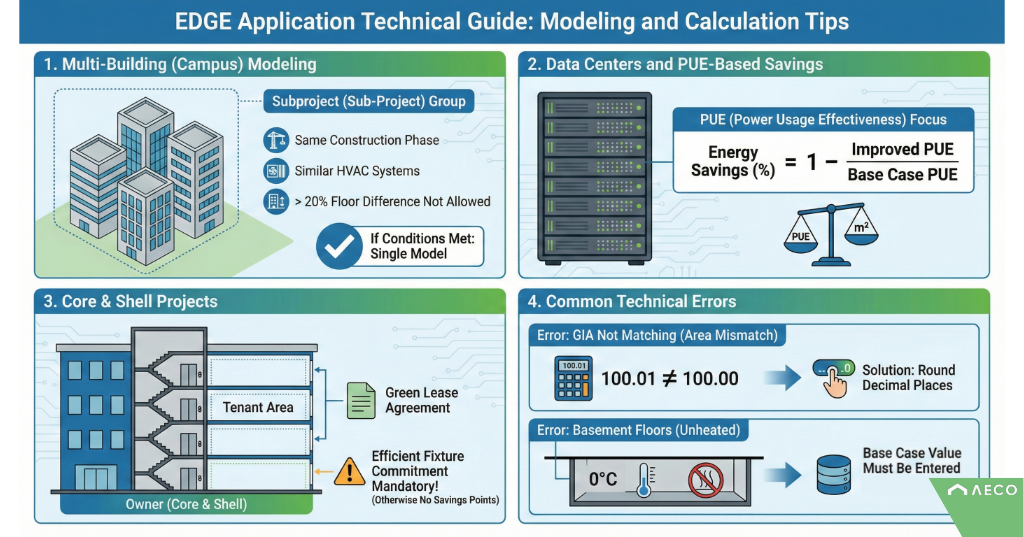
The EDGE App software is celebrated for its simplified, user - friendly interface.However, ease of use can sometimes mask the complexity of the underlying physics and engineering assumptions.For large - scale developments, mixed - use towers, or specialized asset types like data centers, "standard" modeling often falls short.Accurate modeling is critical not just for compliance, but to avoid costly over - spending on unnecessary equipment.
Here, we explore three complex scenarios where expert handling is essential.
1. Multi - Building(Campus) Modeling Strategy
Developers often ask: "Can I certify my 10-block residential complex as a single project?"
The EDGE system allows for grouping buildings into a "Subproject" , which streamlines the certification process significantly.Instead of issuing 10 individual certificates, you can manage them as a portfolio.
The Rules of Grouping:
To group buildings, they must share distinct characteristics:
- Construction Phase: All must be at the same stage(Design or Construction).
- Topology: They must use similar envelope materials(walls, glazing) and HVAC systems.
- Geometry: Floor counts and orientation should not deviate by more than ~20 %.
The AECO Approach: We analyze your master plan to determine the optimal grouping strategy.Incorrect grouping can lead to "audit rejection," forcing a restart.We ensure your documentation supports the aggregate model, saving you thousands in registration fees.
2. Data Centers: The PUE Metric
Data Centers are unique beasts.Unlike offices where we count kWh / m², EDGE evaluates Data Centers based on PUE(Power Usage Effectiveness) .
The formula for savings is derived from:
Critical Modeling Detail:
The "Base Case PUE" is provided by EDGE based on location.Your "Design PUE" must be calculated precisely, factoring in IT load, cooling efficiency, UPS losses, and lighting.
- Trap: A small error in the IT load assumption can skew the PUE drastically.
- Solution: We work with your MEP engineers to validate the PUE calculation spreadsheet before inputting it into EDGE, ensuring it withstands the scrutiny of global auditors.
3. Core & Shell vs.Tenant Fit - Out
For commercial office towers or retail malls, the developer often only builds the "Core & Shell"(Base Building), leaving the interior fit - out to future tenants.
How do you certify a building that is half - empty ?
EDGE has specific protocols for this.You must define which systems are "Scope 1" (Developer Control) and "Scope 2" (Tenant Control).
The Green Lease Requirement:
If you want to claim savings from tenant - controlled items(like lighting fixtures or internal AC units), you MUST have a "Green Lease Agreement" or "Tenant Sustainability Guide" attached to the sales / lease contract.
- Without this legal clause, EDGE assumes tenants will install the most inefficient equipment possible(worst -case scenario), likely causing you to fail the 20 % threshold.
- AECO Service: We draft these Green Lease clauses for you, ensuring they are binding enough for certification but flexible enough for commercial viability.
4. Operational & Geometric Nuances
"GIA Not Matching" Errors
A frequent error during the audit is the mismatch between the "Gross Internal Area"(GIA) calculated in the EDGE App vs.the architectural CAD drawings.
- Why it happens: The App builds GIA from the "bottom up"(sum of room areas).CAD drawings often calculate GIA "top down"(outline of the floor).
- The Fix: We strictly harmonize the "Area Schedule" early in the process.We define clearly what is excluded(shafts, structural columns) to ensure the numbers match down to the decimal, preventing audit delays.
Basement & Unconditioned Spaces
Standard energy modeling assumes all spaces are heated / cooled.Basements(parking, storage) are often unconditioned.Modeling them as "conditioned" artificially inflates savings(cheating), while ignoring them can miss lighting efficiency opportunities.We configure the "zone types" correctly to reflect physical reality.
Mastering these details is what separates a smooth certification from a painful one.
To see how we navigate these technicalities from start to finish, review the roles involved:
[EDGE Expert and Auditor: Understanding the Roles, Workflow, and Audit Process](/en/blog/edge-expert-vs-auditor).