

Preparing for EDGE Audit: Critical Points for Site Visit
What to expect during the EDGE site audit? Water flow tests, energy and material verifications, remote audit conditions and the sampling method.
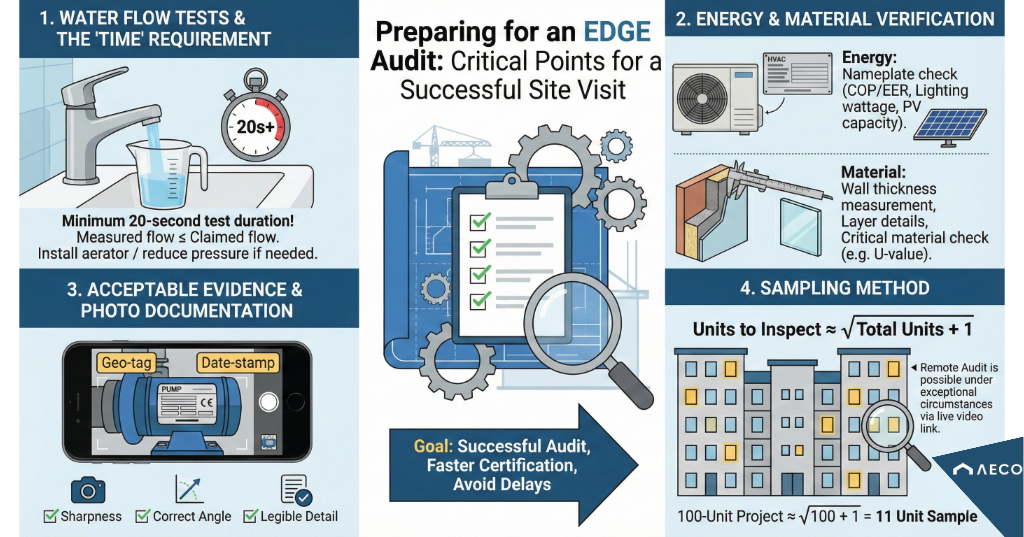
Passing the site audit is essential not only for obtaining the certificate, but also for avoiding re - audits, delays and additional costs.For this reason, both project teams and owners need to pay special attention to a number of key points before the audit takes place.
Water Flow Tests and the Time Requirement
In EDGE, water efficiency is not assessed solely based on catalog data.The savings claimed in the certification must be confirmed through on - site flow measurements.
During the audit:
- Water pressure and flow rates are checked for basin taps, shower heads and other fixtures,
- A measuring container(e.g., 1 - liter jug) and a stopwatch are used to run water flow tests.
According to the EDGE Auditor Guide:
- Each flow test must run for at least 20 seconds .
- If the measured liters per minute(L / min) value is higher than the value entered in the EDGE App, the project team is expected to:
- Install aerators / flow restrictors if needed,
- Adjust valve settings to reduce pressure, and
- Implement any additional measures required to guarantee the targeted flow rate,
and then repeat the test.
For this reason, it is good practice for the project team to commission and adjust all fixtures before the official audit, and to carry out internal spot checks so that no surprises arise on the day of the site visit.
Energy and Material Verification
In the Energy category, the audit typically focuses on:
- The capacities of heating and cooling systems,
- The efficiency ratings of equipment(COP / EER, SEER, SCOP etc.),
- The types, quantities and wattages of lighting fixtures,
- The installed capacity and operational status of any solar PV systems.
The Auditor:
- Takes nameplate photos of key equipment, and
- Compares these values with the technical datasheets and EDGE model submitted at design stage.
In the Materials category, the audit may include:
- Measuring wall thicknesses next to window openings,
- Reasonably verifying the build - up of external walls, roofs and slabs,
- Checking whether critical materials have actually been installed as claimed
(e.g., “high - GGBS concrete”, “low - U - value glazing”, etc.).
To facilitate these checks, project teams should:
- Avoid covering equipment labels with decorative cladding,
- Provide accessible points where wall thickness can be measured,
- If possible, leave sample sections or mock - ups on site that clearly show the construction build - up used in the model.
Acceptable Evidence and Photo Documentation
The traceability and reliability of evidence collected during the audit is fundamental.Therefore:
- All photos taken by the Auditor or submitted by the project team should be geo - tagged and date - stamped .
- This proves that the photos belong to the correct project and were taken during the audit period.
Photos should:
- Be sufficiently sharp,
- Be taken from an appropriate angle, and
- Clearly show the element under inspection(for example, the kW rating on a pump label, the L / min value on a fixture, or the Wp capacity of a PV panel).
Creating an internal photo archive in a similar format before the official audit can speed up the process and provide a strong evidence base in case any question arises during the review.
Remote Audit Conditions
In some exceptional circumstances, it may not be possible or safe for the Auditor to travel to the site.Under specific conditions, EDGE allows a Remote Audit.These conditions may include:
- The Auditor having inspected the same project or building at a high coverage rate(e.g. 80 %) within the last 12 months,
- Serious health or safety risks(travel bans, pandemics, armed conflict, etc.),
- Other exceptional situations explicitly approved by IFC or the relevant certification body.
However, purely economic reasons(such as cost savings) are not sufficient on their own to justify a remote audit.
If a remote audit is conducted:
- A site representative(e.g., project manager, facility manager) must connect with the Auditor via live video,
- Water tests, equipment checks and measurements must be performed in real time under the Auditor’s guidance,
- The resulting images and data must be recorded and attached to the audit report.
Sampling Method and Unit Selection
For projects with a large number of residential units or hotel rooms, it is not practical for the Auditor to inspect every single unit.EDGE therefore allows a statistically robust sampling approach.
A commonly used formula for residential projects is:
Number of units to inspect ≈ √N + 1
(N: total number of units)
For example:
- In a project with 100 apartments, the number of units to audit is approximately √100 + 1 = 10 + 1 = 11 .
- These sample units should be chosen randomly and representatively, covering different floors, facades and blocks.
This method:
- Keeps audit time and cost under control, while
- Providing a reliable picture of whether the efficiency measures claimed in the EDGE model have been consistently implemented across the project.
In summary, the better a project team prepares for the EDGE site audit, the smoother the certification process will be—and the lower the risk of revisions, additional evidence requests or repeat visits.