

EDGE Certification Levels and Comprehensive Guide
Everything you need to know about IFC EDGE Green Building Certification. 20% efficiency standard, EDGE Advanced, Zero Carbon levels and detailed process guide for investors.
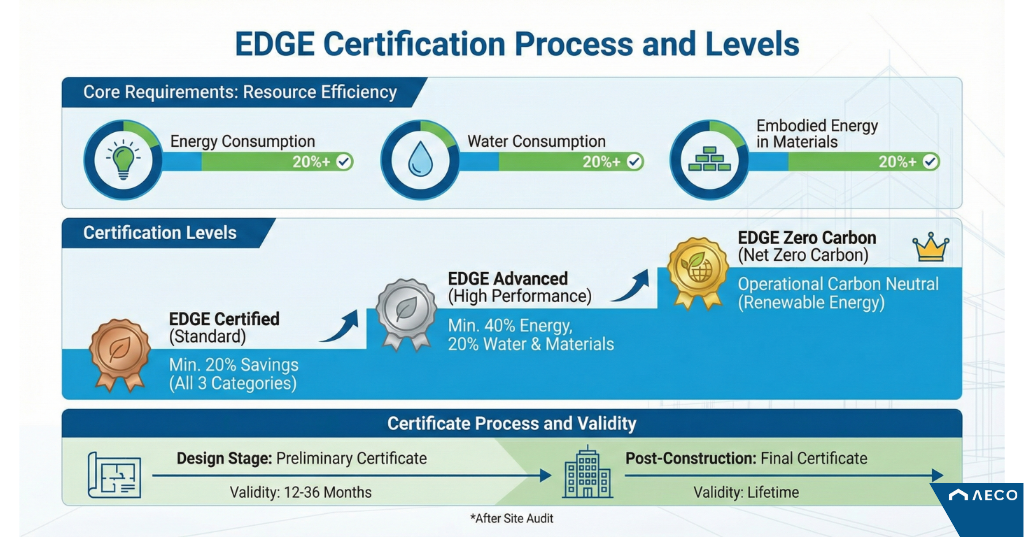
In the rapidly evolving landscape of global real estate, sustainability is no longer just a trend—it is a necessity. Developed by the International Finance Corporation (IFC), a member of the World Bank Group, EDGE (Excellence in Design for Greater Efficiencies) has emerged as the premier green building certification system focused on emerging markets. It offers a measurable, data-driven solution to resource efficiency, helping developers and investors demonstrate the financial and environmental viability of their projects.
The Core Philosophy: Measurable Resource Efficiency
Unlike other certification systems that may rely on qualitative assessments, EDGE is fundamentally quantitative. It focuses on one clear objective: Resource Efficiency. To qualify for certification, a project must demonstrate a minimum of 20% savings in three critical categories compared to a local baseline:
Energy Consumption
Operational energy use
Water Consumption
Sanitary and domestic water
Embodied Energy
Energy in materials
This local baseline is not an arbitrary number. It is dynamically generated by the EDGE Software based on the project's specific location, climate data, and building type. This ensures that the savings are relevant and realistic for the local context.
Why the "20%" Rule Matters?
The 20% threshold was chosen by the IFC to democratize green buildings. It is achievable with standard technologies available in most markets, yet it represents a significant reduction in environmental impact. This approach moves the market from "niche green buildings" to "mass market transformation."
For a deeper dive into how these baselines are calculated, refer to our technical guide:
[EDGE Application Technical Guide: Mastering Complex Modeling Scenarios](/en/blog/edge-app-technical-guide).
Detailed Breakdown of EDGE Certification Levels
EDGE offers a tiered certification structure that rewards higher performance, allowing projects to scale their sustainability ambitions.
EDGE Certified
- ✓ 20% Energy Savings
- ✓ 20% Water Savings
- ✓ 20% Embodied Energy in Materials Savings
EDGE Advanced
- ✓ 40%+ Energy Savings
- ✓ 20% Water Savings
- ✓ 20% Embodied Energy in Materials Savings
Achieves "Zero Carbon Ready" status.
Zero Carbon
- ✓ EDGE Advanced Certification
- ✓ 100% Renewables
- ✓ Carbon Offsets
1. EDGE Certified (The Standard)
This is the entry-level certification. To achieve this, a project must meet the 20% savings requirement in Energy, Water, and Embodied Energy in Materials.
- Market Positioning: Ideal for mass housing projects and commercial developments looking to differentiate themselves.
- Benefits: qualifies for Green Finance loans in many jurisdictions and increases asset value.
2. EDGE Advanced (Zero Carbon Ready)
A prestigious distinction for high-performance buildings. While maintaining the 20% savings in Water and Materials, these projects must achieve at least 40% Energy Savings.
- Significance: This level is often referred to as "Zero Carbon Ready" because focusing on deep energy efficiency is the most cost-effective first step towards true decarbonization.
- Cost-Benefit: Often achieved with passive design strategies (better insulation, window-to-wall ratios) and high-efficiency HVAC, with a marginal cost increase over standard construction.
3. EDGE Zero Carbon (The Ultimate Goal)
The pinnacle of sustainability. A building can only be certified as EDGE Zero Carbon if it is already EDGE Advanced and has been operational for at least one year with 75% occupancy.
- Requirement: The building must neutralize 100% of its operational carbon emissions.
- Methodology: This is achieved through a combination of extreme energy efficiency, on-site renewables, off-site green power procurement, and high-quality carbon offsets.
For a strategic roadmap on reaching this level, read our detailed analysis:
[EDGE Zero Carbon: The Complete Roadmap to Net Zero Buildings](/en/blog/edge-zero-carbon-roadmap).
The Certification Lifecycle and Validity
Understanding the validity of the certificate is crucial for asset management and marketing strategies. The process is divided into two distinct phases.
Phase 1: Preliminary Certificate (Design Stage)
This certificate is issued based on the design documentation. It serves as a validation that the project design meets EDGE standards.
- Purpose: Used to market the project to buyers ("Green Building Process") and to secure preliminary green financing.
- Validity: It is temporary. It expires 12 months after the building is completed or 36 months after issuance, whichever comes first.
Phase 2: Final Certificate (Post-Construction)
This is the permanent certification. It is issued only after an EDGE Auditor has visited the completed building to verify that all design stage strategies were correctly installed.
- Validity: The Final EDGE Certificate is valid for the lifetime of the building.
- Re-certification: Unlike some other systems, EDGE does not require periodic renewal unless the building undergoes major renovations that alter its structural or mechanical performance.
The Role of AECO in Your Certification Journey
Navigating these technical requirements can be complex. As your EDGE Expert, AECO manages the entire lifecycle—from the initial feasibility study and energy modeling to the final audit coordination. We ensure that your project not only meets the minimum requirements but does so in the most cost-effective way possible.
To understand the specific human resources involved in this process, learn about the roles here:
[EDGE Expert and Auditor: Understanding the Roles, Workflow, and Audit Process](/en/blog/edge-expert-vs-auditor).