

EDGE Expert and Auditor: Understanding the Roles, Workflow, and Audit Process
What is the difference between EDGE Expert and Auditor? Conflict of interest rules, audit workflow and responsibilities explained.
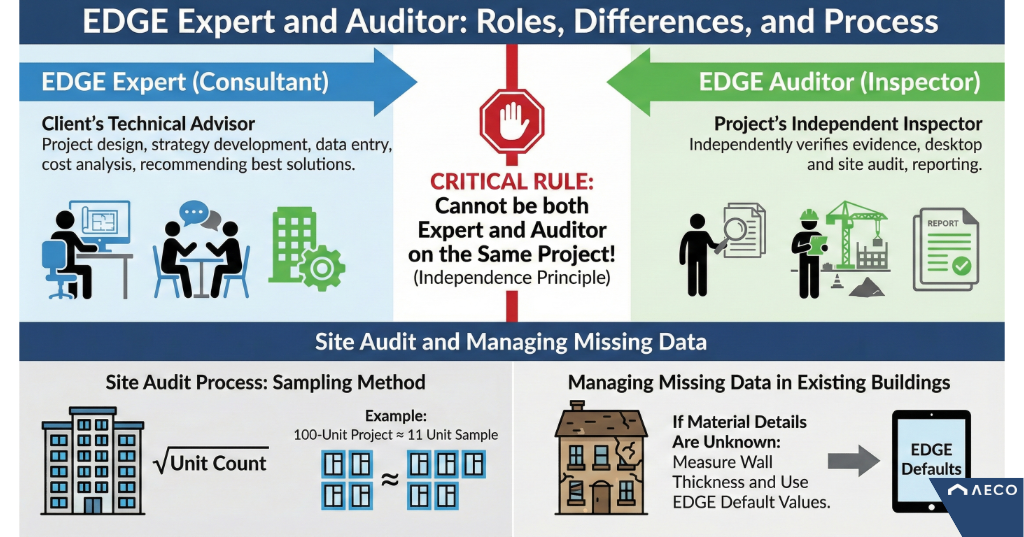
A successful EDGE certification requires a specifically structured team.To ensure the credibility of the system, the International Finance Corporation(IFC) mandates a strict separation of duties between the consultants who design the building and the inspectors who verify it.
Understanding the distinction between the EDGE Expert and the EDGE Auditor is critical for setting up your project workflow correctly.
The EDGE Expert: Your Strategic Advocate
The EDGE Expert is a professional accredited by the IFC to provide advisory services.Think of the Expert as your "Coach."
- Client Side: The Expert works for the client / developer.
- Responsibilities:
- Conducting the initial feasibility analysis.
- Advising the design team on the most cost - effective green strategies.
- Entering data into the EDGE Software and managing the self - assessment.
- Preparing the evidence documentation for the audit.
- Why hire AECO ? While it is technically possible for a client to do this internally, the complexity of technical modeling often leads to errors.As your Expert, AECO optimizes your selection of systems to save costs while ensuring you pass the audit on the first try.
The EDGE Auditor: The Independent Judge
The EDGE Auditor is neutral third - party inspector.Think of the Auditor as the "Referee."
- Independent: The Auditor cannot be an employee of the developer or the design firm.They must be financially and operationally independent to prevent Conflict of Interest(COI).
- Responsibilities:
- Reviewing the file prepared by the Expert.
- Issuing the official "Audit Report."
- Conducting the physical site visit upon building completion.
- Recommending the project for certification to the Certification Provider(e.g., GBCI, SGS - Sintali).
The Step - by - Step Workflow
How do these roles interact during the project lifecycle ?
Step 1: Workshop & Strategy(Expert)
We(AECO) organize a workshop with your architects and engineers.We define the target(e.g., EDGE Advanced) and select the efficiency measures(windows, HVAC, water fixtures) that fit your budget.
Step 2: Registration(Expert)
We register your project in the global EDGE database.
Step 3: Documentation Gathering(Expert + Team)
We guide your team on exactly what proofs are needed.
- Architecture: Window schedules, roof plans.
- MEP: Cooling capacities, lighting layout.
- Purchasing: Material invoices(for embodied energy).
Step 4: The Design Audit(Auditor)
Once we are ready, we hand over the file to the Auditor.The Auditor reviews the documents.If everything is compliant, they issue the Preliminary Certificate .
Step 5: Construction & Evidence(Expert + Team)
As you build, we ensure that the procured materials match the specs.If the window glass changes, we re - run the model to ensure you remain compliant.
Step 6: The Site Audit(Auditor)
When the building is finished, the Auditor physically walks through the building.They inspect:
- Are the low - flow faucets installed ?
- Is the insulation thickness correct ?
- Is the glass specification as promised ?
They take photos and measurements.
Step 7: Certification(Certifier)
The verification body issues the Final EDGE Certificate .
Managing Data in Complex Audits
For large existing buildings(retrofits), data is often missing.The Auditor cannot just "guess." Strict protocols apply:
- Sampling: For a hotel with 500 rooms, the Auditor doesn't visit every room. They use a square-root sampling method (e.g., visiting ~22 rooms).
- Secondary Evidence: If an invoice is lost, photographs of equipment nameplates or on - site testing reports may be accepted.
AECO’s experience in managing these "data gaps" ensures that even projects with imperfect documentation can successfully navigate the audit process.