

EDGE Materials Calculation: Embodied Carbon and Sustainability
How does the Embodied Carbon approach work in EDGE v3? Alternatives for concrete and cement, envelope choices and using EPDs for custom materials.
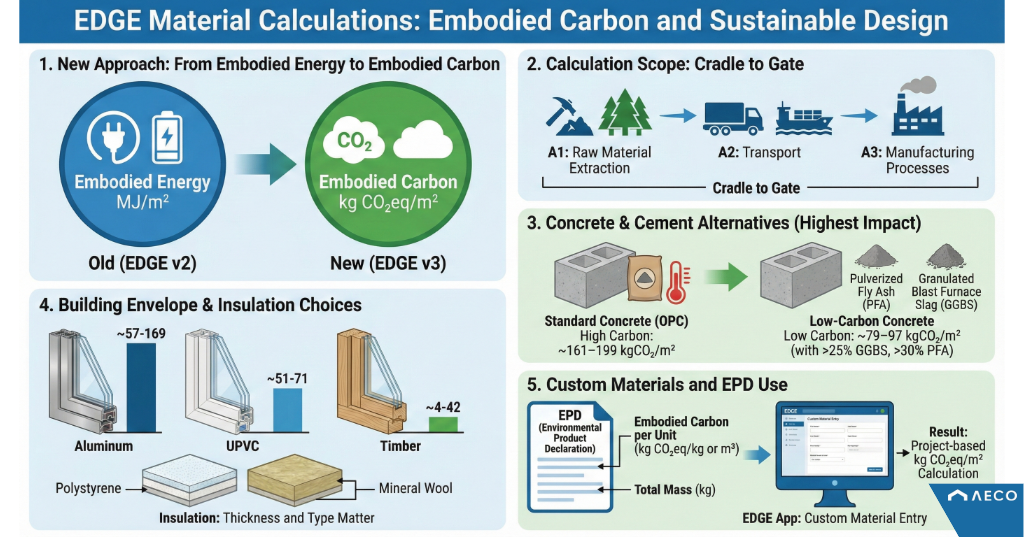
In the construction sector, carbon emissions arise not only from operational energy use(heating, cooling, lighting), but also from the materials used to build the structure.Traditionally, most attention has been paid to reducing energy consumption in operation.Today, however, the climate impact of construction materials has become equally critical.
Reflecting this shift, EDGE v3 introduced a major change in how material efficiency is calculated, moving from “Embodied Energy” to “Embodied Carbon” as the primary metric.As a result, each material’s climate impact can now be tracked directly in kg CO₂eq / m².
The “Cradle to Gate” Approach
EDGE evaluates the environmental impact of materials using a Life Cycle Assessment (LCA) approach aligned with EN 15804 + A2: 2019. The calculations cover:
- A1: Raw material extraction,
- A2: Transport to the manufacturing facility,
- A3: Manufacturing processes.
Together, these stages form the “Cradle to Gate” boundary.In other words, EDGE accounts for the emissions a material generates before it even arrives on site.
This allows project teams to:
- See the embodied carbon load of each building element in kg CO₂eq / m², and
- Compare alternative materials to optimize design decisions from a carbon footprint perspective.
For example, for the same structural thickness, a conventional high - cement concrete wall and a wall using higher shares of supplementary cementitious materials will appear with very different embodied carbon values in the EDGE database.
The Role of Concrete and Cement Alternatives
In many buildings, a large portion of embodied carbon comes from the reinforced concrete structural system.The production of traditional Portland cement(OPC) requires high temperatures, consumes significant energy and generates substantial CO₂ emissions.
EDGE encourages the use of cement replacement materials in concrete design to reduce this impact.In particular:
- Pulverized Fly Ash(PFA)
- Granulated Blast Furnace Slag(GGBS)
can significantly lower the carbon intensity of concrete.
Within the EDGE App:
- Concrete mixes with more than 25 % GGBS , or
- More than 30 % PFA
can achieve much higher savings in the Materials category.For instance:
- A standard reinforced concrete slab may have an embodied carbon of approximately 161–199 kgCO₂/m²,
- While a slab with 25 % GGBS may fall into the 79–97 kgCO₂/m² range.
Across large floor areas, this difference can dramatically reduce a project’s total embodied carbon and make it much easier to exceed the 20 % savings threshold in the Materials category.
Building Envelope and Insulation Materials
Beyond the structural frame, the roof, external walls and windows also play a crucial role in material efficiency.
For window frames, for example:
- Aluminum frames may exhibit embodied carbon values around 57–169 kgCO₂/m²,
- Timber frames may be in the 4–42 kgCO₂/m² range,
- UPVC frames typically fall around 51–71 kgCO₂/m².
Choosing the right frame type is therefore a key design decision, with implications for both operational performance and embodied carbon.
The same applies to insulation materials:
- The thickness, density and production processes of products like polystyrene foam, mineral wool or glass wool all influence the project’s total kg CO₂eq / m².
EDGE provides default embodied carbon values for a wide range of insulation materials, enabling project teams to evaluate insulation thickness + material type combinations from both an energy and carbon perspective.
Custom Materials and the Use of EPDs
Not every product used on a project will have a direct match in the EDGE database.This is where the “Custom Material” feature comes in.
With this option:
- Project teams can manually add local or innovative products that are not yet part of the EDGE library.
- The required data is taken from the product’s Environmental Product Declaration(EPD) .
Typically, the following information is needed:
- The material’s total mass(kg), and
- Its embodied carbon value per unit(kg CO₂eq / kg or kg CO₂eq / m³).
Once these values are entered into the EDGE App, the system automatically converts them into kg CO₂eq / m² at the project level.This approach:
- Allows local low - carbon products to be recognized within a global certification system, and
- Helps projects build a strong narrative around performance, local sourcing and innovation.