

Existing Building vs. Retrofit in EDGE
How to certify existing buildings with EDGE? Retrofit status, material re-use advantage, modeling with uncertain data and the Zero Carbon journey.
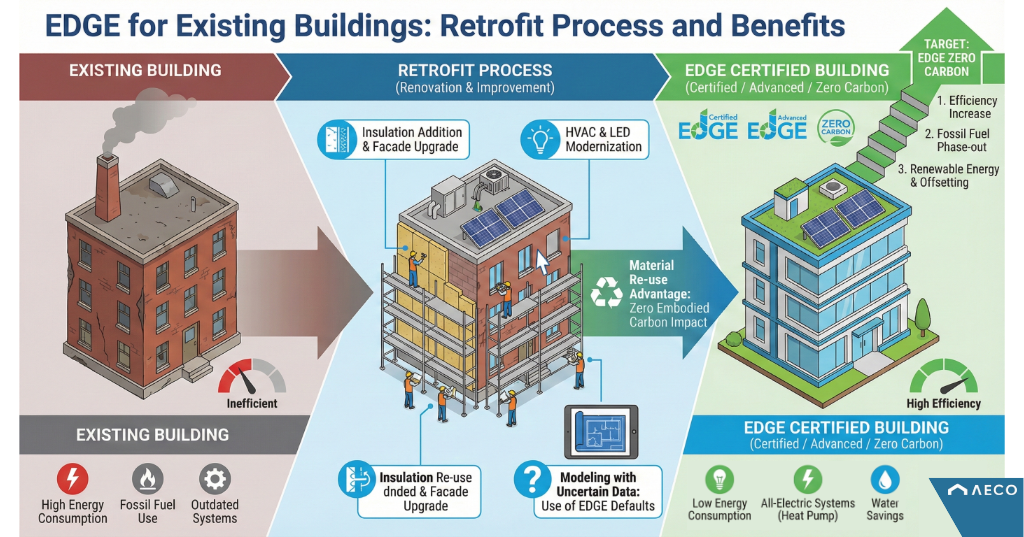
When we talk about sustainability, most people immediately think of new, modern and iconic buildings.In reality, however, one of the most effective ways to reduce global carbon emissions is to improve the existing building stock.A large share of the world’s buildings has already been constructed and will remain in use for decades.Enhancing the energy, water and material performance of these existing assets is therefore critical for meeting climate targets.
IFC’s EDGE(Excellence in Design for Greater Efficiencies) certification is not only designed for new construction.It also provides a practical and data - driven roadmap for existing buildings and major renovation(retrofit) projects.So how does the process of turning an existing building into a “green” building work under EDGE, and how does a project obtain “Retrofit” status ?
Existing Building vs.Retrofit in EDGE
In EDGE, a project’s classification depends on the scope and depth of intervention:
- If a building undergoes a major upgrade to improve energy, water or material efficiency(for example, adding external insulation, replacing the HVAC system with high - efficiency units, or upgrading lighting to LED), the project is classified as a “Retrofit”.
- If the building does not undergo any major renovation and is to be certified largely “as - is” based on its current systems and operational data, it falls under the “Existing Building” category.
In both cases, the fundamental requirement remains the same: compared to the EDGE - generated local base case, the project must demonstrate at least 20 % savings in all three resource categories:
- Energy(operational energy use)
- Water Consumption
- Embodied Energy / Embodied Carbon in Materials
For retrofit projects, the model must accurately represent both the upgraded systems and the existing elements to be retained, so that the savings are realistic and auditable.
The “Re - use” Advantage in Material Efficiency
One of the biggest advantages of retrofit projects under EDGE is found in the Materials category.Many retrofits keep the existing structural frame and envelope, while mainly upgrading systems and interiors.The EDGE v3 methodology includes a specific mechanism to reward the reuse of existing building elements.
- Building elements that already exist and are more than five years old (e.g., floor slabs, roofs, external walls, window frames) can be marked in the EDGE App as “Re - use of Existing Elements”.
- When this option is selected, the EDGE App assumes that these reused elements have zero embodied carbon impact within the model, meaning they do not add additional carbon burden in the Materials category.
This makes it much easier to reach the 20 % savings threshold in the Materials category, especially in projects where the reinforced concrete structure and external walls are retained.For example:
- If an existing building’s external walls are preserved, selecting “X – Re - use of existing wall” in the App effectively neutralizes the embodied carbon associated with those walls.
- Similarly, existing roofs and slabs that will be kept in place can be modeled as “re - use”, recognizing that the project avoids the impacts of demolition and new construction.
This feature is particularly valuable for historic buildings, office conversions and industrial - to - commercial transformations, where the reuse of the existing shell is a core part of the sustainability strategy.
Uncertain Technical Data and Modeling Strategies
In existing buildings, one of the most common challenges is the lack of reliable technical documentation: as - built drawings, material build - ups or insulation details may be incomplete or outdated, especially in buildings constructed 20–30 years ago.
EDGE addresses this reality with a flexible yet robust approach:
- If the U - value(thermal transmittance) of a roof or wall is unknown and its thickness cannot be measured, the project team may use the “Base Case” construction defined by EDGE for the relevant climate zone as a default assumption.
- If the thickness can be measured but the exact material composition is unknown, the dominant material type(for example “reinforced concrete + brick” or “reinforced concrete + aerated blocks”) can be selected and used for calculations.
This approach:
- Avoids creating artificial savings based on unrealistic assumptions, and
- Ensures a reasonable alignment between the model and the measurements that the Auditor will perform on site.
When working with incomplete technical data, the most important aspect for both the Expert and the Auditor is that all assumptions remain consistent, well - documented and aligned with EDGE guidance.
The Zero Carbon Journey in Retrofit Projects
Retrofit projects not only improve current performance; they also play a strategic role on the road to EDGE Zero Carbon.In older buildings in particular:
- Upgrading energy efficiency,
- Switching from fossil fuel systems to all - electric solutions, and
- Integrating renewables and carbon offset strategies
can make the Zero Carbon target more feasible, both technically and financially.
Within EDGE, if a retrofit project aims to achieve EDGE Advanced(40 % energy savings) once the renovation is complete, it can apply for a “Preliminary EDGE Zero Carbon” certificate even before construction works are finished.To do so:
- The project owner must commit to completing the retrofit within two years, and
- Offset current operational emissions during this period using eligible carbon offsets.
This mechanism encourages the gradual transformation of existing buildings into modern, efficient and climate - friendly assets.For investors with corporate climate targets, the combination of retrofit + EDGE Zero Carbon can deliver significant financial, environmental and reputational benefits.