

EDGE Zero Carbon: The Complete Roadmap to Net Zero Buildings
Technical guide to achieving EDGE Zero Carbon. Fossil fuel restrictions, renewable energy procurement, offsets and the step-by-step process.
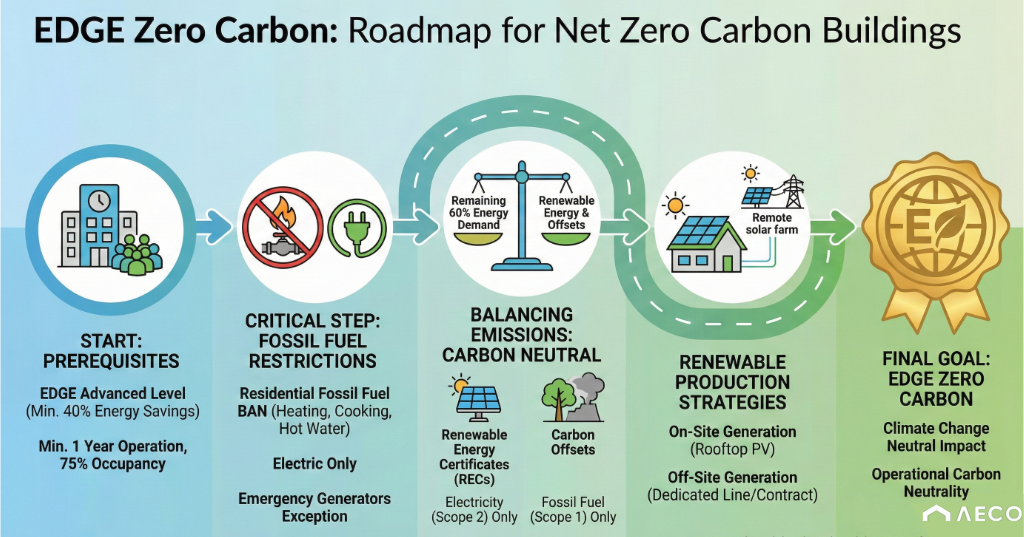
The concept of "Net Zero" is transforming the global construction industry.As governments and corporations commit to decarbonization targets, EDGE Zero Carbon certification serves as a verified, internationally recognized seal that proof a building's operational neutrality. But achieving this prestigious status requires more than just good intentions; it demands a rigorous, disciplined engineering and procurement strategy.
The Foundation: Efficiency First
It is a common misconception that you can achieve Net Zero simply by buying enough solar panels or carbon credits.The EDGE methodology strictly follows the "Efficiency First" principle.
Before a project can even apply for Zero Carbon certification, it must meets two non - negotiable prerequisites:
1. EDGE Advanced Certification : The building must first demonstrate 40 % energy efficiency on site compared to the base case. This ensures that the energy demand is minimized before we attempt to supply it with renewables.
2. Operational Data : Unlike design - stage certifications, Zero Carbon is performance - based.The building must have been operation for at least one year and reached 75 % occupancy .Real meter data(electricity, fuel, district cooling, etc.) is required.
For residential projects, the use of fossil fuels(natural gas, coal, oil) for space heating or cooking is strictly prohibited under EDGE Zero Carbon.The project must be fully electrified(e.g., Heat Pumps, Induction Cooktops).For commercial projects, limited fossil fuel use matches with offsets might be permitted, but electrification is strongly encouraged.
The Three Pillars of the Zero Carbon Strategy
Once the 40 % efficiency baseline is met, the remaining energy demand must be met through a hierarchy of green energy sources.
1. On - Site Renewable Energy
This is the most valuable form of energy.Solar PV panels on roofs or facades, wind turbines, or solar thermal systems directly reduce the building's draw from the grid. EDGE prioritizes this above all else. However, for dense urban high-rises, on-site generation is often insufficient to cover 100% of demand.
2. Off - Site Renewables & RECs(Renewable Energy Certificates)
If on - site generation isn't enough, the project must procure green energy from the grid. This is done via Power Purchase Agreements (PPAs) or RECs.
- What is a REC ? A REC certifies that 1 Megawatt - hour(MWh) of renewable electricity was generated and fed into the grid.buying RECs allows a building to claim that its consumed electricity is "green," effectively neutralizing Scope 2 emissions.
- Validity: RECs must be purchased annually to match the building's consumption.
3. Carbon Offsets
This is the final resort.Carbon Offsets are used to neutralize Scope 1 emissions(direct fuel combustion, e.g., backup diesel generators or gas boilers in commercial buildings).
- Quality Matters: Not all offsets are accepted.They must be certified by recognizable standards like Gold Standard or VCS(Verified Carbon Standard) .
- Limitation: You cannot use offsets to cover electricity consumption; you must use RECs for that.Offsets are strictly for direct fuel emissions.
The Roadmap: From Design to Zero
Achieving this target requires planning from day one, even if the certification comes years later.
1. Design Phase :Focus on passive design.Minimize solar heat gain, optimize natural daylight, and select high - COP HVAC systems.Ensure the roof is "Solar Ready."
2. Construction : Install the efficient systems and any on - site renewables.
3. Year 1 - 2 Operations : Monitor energy consumption meticulously.Calibrate the BMS(Building Management System) to prevent energy drift.
4. Certification : Gather 12 months of utility bills, purchase necessary RECs / Offsets, and undergo the EDGE Zero Carbon audit.
AECO’s consultancy services cover this entire spectrum.We help you not only model the efficiency but also structure the procurement of RECs and Offsets to ensure compliance at the lowest market cost.
For more technical details on how to model these renewable systems in the EDGE App:
[EDGE Application Technical Guide: Mastering Complex Modeling Scenarios](/en/blog/edge-app-technical-guide).